

Have a Friend Officiate Your Wedding (Legal, Personal, and Not Awkward)
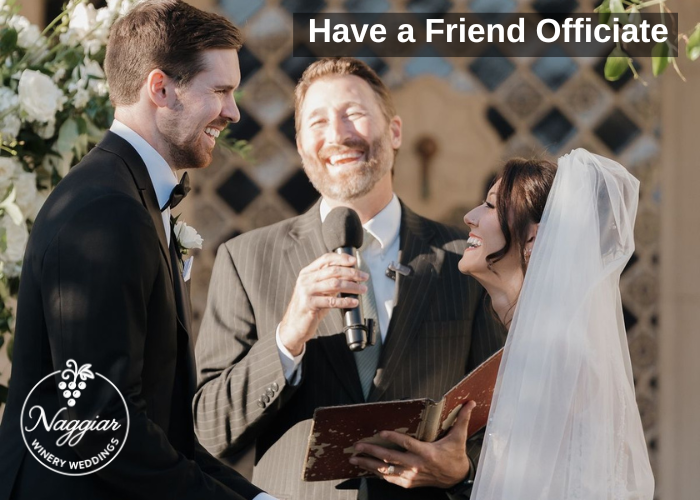
Want vows that sound like you instead of a template from 1997? Ask a friend or loved one to officiate. Here’s the no-fluff guide—legal steps, timelines, scripts, and the “please don’t blow it” checklist.
Why choose a friend officiant
Personal: Stories only they can tell.
Flexible: Spiritual, secular, mixed traditions—your call.
Budget-smart: Put savings toward photo, florals, or a real late-night bite.
The legal part (do this first)
1) Confirm who can officiate.
Most U.S. states accept ministers ordained online (e.g., interfaith/non-denominational). Some counties require the officiant to register before the ceremony. A few places ban online ordinations—verify yours.
2) Get ordained.
Takes minutes and is usually free. The officiant should order any required proof (ordination certificate, letter of good standing) if your county asks.
3) Check local rules.
Look up the county clerk where you’ll marry (license issued and ceremony location rules can differ). Confirm:
Whether officiant registration is required
Deadline and docs to bring (ID, certificates)
Who returns the license (usually the officiant within 3–10 business days)
4) License logistics.
Apply within the valid window (often 30–90 days).
Bring required IDs and witnesses (some states need 2).
Make sure names/addresses are legible on the final form. Ink, not pencil. No wine stains.
5) Script must include:
Your names, intent (“Do you take…?”)
Pronouncement (“I now pronounce…”)
Signatures: couple, officiant, witnesses (where required)
Pro move: Print a ceremony packet—script + license + fill-in cheat sheet—on a clipboard.
Timeline (copy/paste)
6–8 weeks out: Confirm legal requirements, ordain, design ceremony outline.
4 weeks: Draft script; get your vows to the officiant if they’re introducing them.
2 weeks: County registration (if needed).
1 week: Final script; print packet; pack black pen + backup pen.
Rehearsal day: Full run-through with mic, processional, and recessional.
Wedding day: Arrive 30 minutes early, check license, check mics, breathe.
Build a simple, modern ceremony (10–15 minutes)
1) Welcome (30–45 sec)
Set the tone; name the couple; thank guests.
2) Story (60–90 sec)
One specific anecdote—why they work together. Keep it PG.
3) Readings/ritual (optional, 60–90 sec)
A short quote, cultural or family element.
4) Declaration of intent (30 sec)
“Do you take…?” / “We do.”
5) Vows (2–3 min total)
Read or repeat. Tissues on standby.
6) Rings (60 sec)
“I give you this ring…”
7) Pronouncement + kiss (30 sec)
Say the words clearly and step aside for the photo.
8) Closing (15 sec)
“Everyone up—let’s celebrate ___ & ___!”
Mic & staging (so people hear it and the photos slap)
Two lav mics (officiant + one partner) or one handheld on a stand angled between you.
Officiant steps two feet back during vows/rings; re-enter for pronouncement.
Angle the trio 30° toward guests for faces in photos (not backs).
Have a wind plan: foam cover or handheld mic if breezy.
Friend-officiant do’s & don’ts
Do
Keep it under 12 minutes.
Speak in short sentences, smile, pause for laughs.
Edit jokes to one (clean) line.
Bring water, not whiskey.
Rehearse once out loud with the actual mic.
Don’t
Roast the couple, mention exes, or share inside jokes no one gets.
Wing it.
Forget the license (yes, it happens).
7-minute script (steal this)
Welcome
“Good evening! I’m [Name], honored to officiate for [A] and [B]. We’re here because two excellent humans decided life is better shared—and they’re right.”
Mini-story
“I’ve watched them turn ordinary Tuesdays into tiny adventures: [one specific example: soup at 2 a.m., sunrise drives, caring for family]. That’s what partnership looks like.”
Declaration of intent
“[A], do you choose [B] as your partner in life—your teammate, confidant, and favorite person—through every season that’s coming?”
“I do.”
“[B], same question.”
“I do.”
Vows (read your own or repeat after me)
Rings
“These rings are simple circles—no beginning, no end—like the promise you’re making. [A], place the ring on [B]’s finger and repeat: ‘With this ring, I choose you.’” (repeat with B)
Pronouncement
“By the authority vested in me by the State of [State], I now pronounce you married. You may kiss!”
Closing
“Friends and family, it is my joy to introduce [A] & [B]! Let’s celebrate.”
Paperwork checklist (after the kiss)
☐ License filled out clearly (no cross-outs)
☐ Names and dates match the application
☐ Officiant title written as accepted by the county (e.g., “Minister,” “Officiant”)
☐ Witness lines signed (if required)
☐ Officiant returns the license on time (mail vs in person)
Backup plans (because life)
Backup officiant: designate one person who can read the script if Plan A gets sick.
Weather: print rain-version cues (shorter lines, move to covered spot).
Tech fail: project without mics—shorten lines and speak up.
FAQ
Can a friend officiate everywhere?
Almost everywhere, but not everywhere. A few counties/states reject online ordination. Always call the issuing clerk.
Do they have to register?
Some counties require pre-registration or a one-day authorization. Others don’t. Check.
What should they wear?
Solid colors, no loud patterns, no sunglasses. Bring a clip for the mic pack.
Bottom line
A friend-officiated ceremony can be the most personal part of your day—if you treat it like the main event: handle the legal steps early, keep the script short and real, rehearse with a mic, and triple-check the license. Do that, and your “we do” will land exactly how you want it to—clean, heartfelt, unforgettable.
Want me to tailor the script to a vineyard ceremony (wind plan, golden-hour cues, wine ritual, or interfaith elements)? Say the word and I’ll drop in the exact lines.
