

Having Both Parents Walk the Bride Down the Aisle: How It Works (and Why It’s Lovely)
Quick Answers (read this, then go back to cake tasting)
Yes, it’s a thing—and it’s common in Jewish ceremonies and increasingly popular in modern ceremonies too.
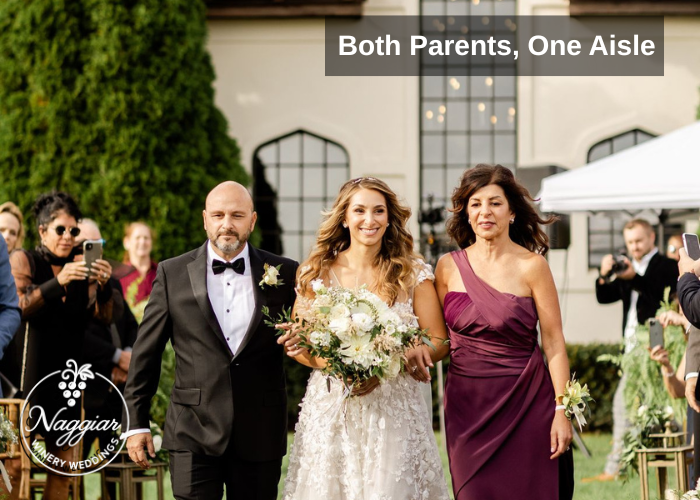
Standard setup: bride in the middle, dad on left / mom on right (or swap if you prefer).
Key practical tip: make sure your aisle is wide enough for three-across (and a dress).
Meaning > tradition: you can frame it as “escorted by both parents” instead of “given away.”
If you’re planning a winery wedding in the Sierra Foothills—especially around Grass Valley—this is a beautiful, modern-feeling choice that still nods to long-standing traditions (and photographs like a dream).
Why couples choose both parents walking the bride down the aisle
People do this for lots of reasons—none of them require a TED Talk at the ceremony:
Inclusion: honors both parents’ roles (or two parental figures).
Cultural tradition: in many Jewish processionals, both parents escort the bride (and often the groom is escorted too).
Modern meaning: it can feel less like a “handoff” and more like a “we’re walking with you into your next chapter.”
How to do it: the simplest, smoothest setup
The classic formation
Bride in the center
Parent 1 on the left, Parent 2 on the right (many guides list father left / mother right, but you can choose what feels right).
Where do hands go?
Option A (easy + elegant): each parent offers an elbow; bride lightly holds both.
Option B (bouquet-friendly): bouquet centered; parents hold your forearms lightly.
Option C (no bouquet): hands linked/held—whatever feels natural.
Pace + timing (aka: don’t sprint)
Walk a hair slower than you think. If your song is 1:30–2:00 long, that’s plenty—most aisles don’t need the director’s cut.
Processional order tips (so nobody panics at the front row)
In many modern ceremonies, the processional order is flexible—what matters is clarity. That said, mainstream processional guides explicitly include the option of both parents escorting the bride.
If you’re doing a Jewish ceremony, many examples show:
Groom escorted by parents
Bride escorted by parents
If you’re doing a non-religious ceremony, you can still use the same “both parents escort” moment—just tell your officiant and coordinator what you want.
Checklist you can copy into your planning notes
☐ Confirm aisle width works for three people (plus dress).
☐ Decide your walking order (who stands on which side).
☐ Pick your entrance song timing (usually 60–120 seconds).
☐ Do one quick practice walk (seriously—one).
☐ Photographer your “pause point” (halfway? end of aisle? quick hug?).
☐ Decide what happens at the front (hugs, hand squeeze, parents take seats, etc.).
How to explain it (if anyone asks)
You can keep it simple:
“I wanted to be supported by both parents for that moment.”
“We’re skipping the ‘giving away’ vibe—this feels more us.”
Short. Sweet. No debate club.
Make it flow at a winery ceremony
At Naggiar Winery Weddings, the aisle moment is often paired with golden-hour light and a relaxed timeline—so the key is scheduling it so you’re not rushing (or missing your best photo window).
Helpful next steps:
Planning smaller? Explore micro weddings at Naggiar.
Get ceremony + aisle inspo in the real wedding photo gallery.
Want help building a timeline that actually breathes? Contact Naggiar Winery Weddings.
Pro Tips
Put the bride in the middle and keep spacing even—your photos will look balanced.
Have a “pause point” halfway down for a breath + smile (it helps nerves).
If a parent has mobility concerns, slow the pace and shorten the aisle moment—beautiful > lengthy.
Common Mistakes
Not rehearsing at all—one quick walk-through prevents awkward arm tangles.
Choosing a song with a 45-second intro… while you’re already at the front.
FAQs
Q: Is having both parents walk the bride down the aisle traditional?
A: In many Jewish ceremonies, yes—both parents escort the bride (and often the groom is escorted too).
Q: Which side should each parent walk on?
A: A common format is bride in the middle with father on her left and mother on her right—but you can choose what’s comfortable and meaningful.
Q: What if my aisle is narrow?
A: Consider a staggered walk (parents slightly behind), or have one parent meet you halfway—many couples do this for comfort and space.
Q: Does this replace the “giving away” question?
A: It can. Many couples skip that language entirely and frame it as being escorted/supporting the couple.
Q: Can a stepparent or grandparent be included instead?
A: Absolutely—modern processionals are flexible, and many guides encourage making the walk reflect your relationships.
